This post contains affiliate links. If you buy through them, we may earn a commission at no extra cost to you. We research every pick from manufacturer specs, independent testing and verified owner reviews — read how we chose below.
Every space heater is 1,500 watts. So what are you actually choosing?
Walk into any store in November and the wall of heaters looks like a wattage contest — and it is a tie. Almost every plug-in space heater in America tops out at the same 1,500 watts, because that is what a standard household outlet can safely supply. A $30 heater and a $300 heater, run at full power for an hour, produce the same heat and cost the same on your electric bill. So the real choice is never “how much heat.” It is how the heat is delivered (fast fan blast, even whole-room circulation, or silent radiant warmth), how precisely it cycles (a good thermostat is the only real energy saver), and — above everything else in this guide — what the heater does when something goes wrong: when it tips, when it overheats, when a curtain drifts too close. This guide ranks five heaters on exactly those three things, room by room. If a heater is on your Fall Home Maintenance Checklist, this is the deep version of that line.
How we chose: The five heaters below were selected from manufacturer spec sheets and manuals, independent roundups and testing (Consumer Reports’ buying guide, Tom’s Guide’s tested reviews, Weather.com and 2026 homeowner roundups) and verified owner-review patterns. We don’t claim hands-on testing we didn’t do. Three rules governed the picks. First, safety features were verified per model, never assumed from the brand — and that rule changed this guide: the most famous tower in the category, the Lasko 755320, was excluded because Lasko’s own comparison table lists it with no tip-over switch, and its equally famous budget sibling, the 754200, was excluded for the same reason and replaced by the 754201, which has one. Check the exact model, not the logo. Second, every pick had to own a different room job — all-round tower, even whole-room heat, silent bedroom heat, fast modern ceramic, honest budget — because “best” without a room attached is marketing. Third, where a maker doesn’t publish a comparable figure, the table says “check product page” instead of guessing. Prices are street ranges checked in October 2026 and move with seasonal promotions — check the current price on the product page.
Watch the guide
The 5 heaters at a glance
| Role | Pick | Type | Street price |
|---|---|---|---|
| ⭐ Best overall tower | Lasko Ellipse CT18950 | Ceramic tower | Check product page |
| Best whole-room / even heat | Vornado MVH | Fan-forced vortex | ~$80–100 class |
| Best silent / bedrooms | De’Longhi EW7707CM ComforTemp | Oil-filled radiator | ~$130 class |
| Best fast modern ceramic | Dreo DR-HSH004 | PTC ceramic, compact | Check product page |
| Best budget (with tip-over) | Lasko 754201 | Ceramic, tabletop | ~$30 class |
Grab the free printable: our Space Heater Safety & Sizing Cheat Sheet (PDF) has this table plus the sizing table, the running-cost table and the full safety checklist — link at the end.
First, the physics: what 1,500 watts really means
Energy experts make the same point every winter, and it is the most liberating fact in this category: every standard plug-in electric heater converts essentially 100% of the electricity it uses into heat. Ceramic, oil-filled, infrared, fan-forced — at the same wattage, for the same runtime, the heat and the bill are the same. What differs is delivery:
- Ceramic fan-forced (Picks 1, 4, 5) heats up in seconds and pushes warm air at you. Fastest comfort, some fan noise, and the air right in front of it is much hotter than the room’s corners.
- Vortex whole-room (Pick 2) uses a fan too, but the design goal is different: circulate the room’s air until the whole volume is one temperature, instead of beaming heat in one direction.
- Oil-filled radiant (Pick 3) heats sealed oil inside metal fins, which then warm the room by convection and radiation. Slow to start, completely silent, and it keeps giving off heat for a while after it cycles off.
The sizing rule: plan on roughly 10 watts per square foot of supplemental heat. A 1,500 W heater is therefore a ~150 sq ft closed-room heater at full output — which is why maker coverage claims should always be read against the room’s actual size, doors and insulation, and why a 400 sq ft open-plan living area is a two-zone problem, not a “buy a bigger heater” problem (there is no bigger plug-in heater).
What one hour costs (do this math before you blame the heater): a 1,500 W heater running flat-out uses 1.5 kWh per hour. At the US residential average of about 18.3¢ per kWh (EIA, 2026), that is ≈27¢ per hour, ≈$2.20 for an 8-hour day, ≈$66 for a month of 8-hour days. In practice a heater with a working thermostat cycles — it only draws full power part of the time — so the real bill is usually well under the flat-out figure. That is the whole energy-saving story in this category: not a magic element, but a thermostat that cycles accurately, a low setting you actually use, and heating the room you’re in instead of the whole house.
The safety section (read this before the picks — it IS the guide)
Space heaters are involved in roughly 30% of home heating fires but about 73% of home heating fire deaths (NFPA averages, 2020–2024), and nearly half of heating fires happen from December to February. Those numbers are not a reason to avoid a heater — they are the reason the rules below, drawn from NFPA, US Fire Administration and CPSC guidance, are printed before the product list:
- The 3-foot rule. Keep anything that can burn — bedding, curtains, furniture, clothing, paper — at least 3 feet from the heater, in every direction. Keep a 3-foot kid-and-pet-free zone around it too.
- Direct to the wall. Never an extension cord, never a power strip. A heater draws 12.5 amps continuously; cords and strips not built for that load overheat. If the plug, outlet or faceplate feels hot, stop using it and have an electrician check the outlet.
- Flat, hard, on the floor. A solid level surface, out of foot traffic, never blocking an exit, cord never under a rug or pinched in a doorway.
- Off when you leave. Off when you sleep. This is the official guidance even for models with every safety feature. A timer is a convenience for waking hours, not a licence for unattended running.
- Buy the checklist, not the brand: a seal from a recognised testing lab (UL, ETL or CSA), a thermostat, overheat protection, and an automatic tip-over shut-off. Then verify them on the exact model — as this guide’s exclusions show, the same brand sells models with and without a tip-over switch.
- Seasonal habits: vacuum dust from grilles, inspect the cord and plug before the season, check your model against recalls (SaferProducts.gov / CPSC), and test your smoke alarms monthly — the alarms you check with the rest of your Essential Tools safety kit.
One boundary, stated plainly: a space heater warms a room. It does not fix the cold room’s cause — drafts, failed insulation, or a damp, cold basement. If the cold room is cold and damp, the heater is the last step, not the first; our damp basement guide is the first.
The 5 heaters, matched to the rooms in this guide
1. ⭐ Best overall tower: Lasko Ellipse CT18950
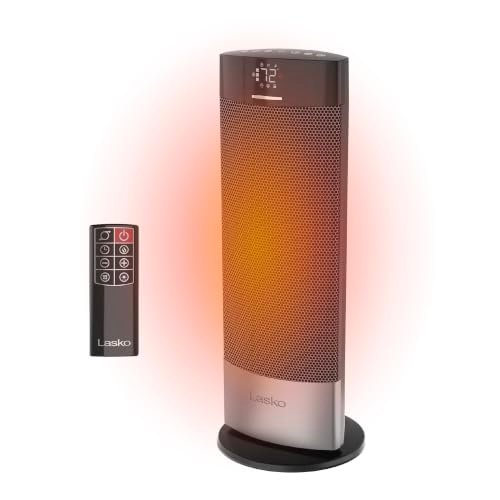
The default first heater for most new homeowners, and this guide’s hero, because it is the tower that passes the full checklist: a 1,500 W ceramic tower (3 heat settings) with 120° widespread oscillation, a digital thermostat (60–90°F), a 12-hour timer, a remote — and the safety package verified in its listing and manual: tip-over switch, thermal overload (overheat) protection, cool-touch housing and a child lock, with a 3-year warranty behind it. At about 19 inches tall and 4.1 lb with a listed 200 sq ft class coverage, it is sized for the living room, the main bedroom and the home office — the rooms a tower’s small footprint and torso-height output suit best. Lasko rates it under 40 dB (a maker figure, reported as one), which puts it in the fan-noise class you can talk over.
Honest trade-offs: a tower is tall and narrow by design, so it is the most tip-prone shape here — the tip-over switch is the mitigation, and the placement rules above are still the rule, not a formality. It is a one-room supplemental heater, not a whole-floor answer; on high you will hear the fan (Pick 3 is the silent answer); and there is no app or smart-home control.
2. Best whole-room / even heat: Vornado MVH
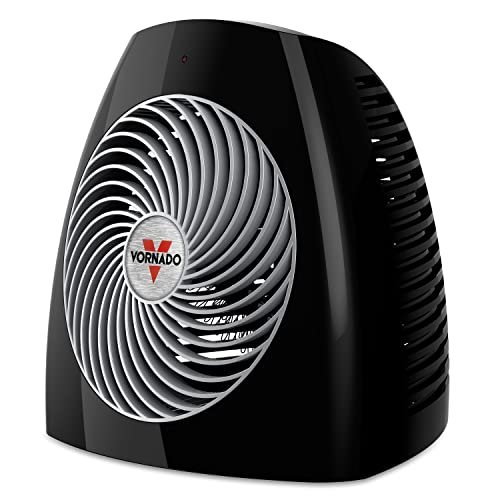
The heater for the reader whose complaint is not “cold” but “uneven” — one hot chair, cold corners. The MVH’s Vortex circulation is built to move the room’s entire air volume until it evens out — Vornado rates it for rooms up to about 256 sq ft — at 1,500 W across 3 heat settings (750 / 1,125 / 1,500 W) with a mechanical thermostat knob (7 settings). It is the long-running classic of Vornado’s whole-room line — the simple, dial-only formula the brand built its name on, with a decade-plus of owner data behind it — and the maker’s listed safety set is the complete one: tip-over protection, an automatic safety shut-off for overheating, and a cool-touch exterior. Its warranty is the longest here — 5 years.
Honest trade-offs: no oscillation (the vortex replaces it), no remote, no display, no timer — mechanical dials only, and the design is visibly an older one: two knobs and a grille, nothing digital. It is a small-to-medium closed-room heater; an open plan will defeat its circulation just like everyone else’s.
3. Best silent / best for bedrooms: De’Longhi EW7707CM ComforTemp

The only fanless pick, and the bedroom answer: an oil-filled radiator (1,500 W) whose sealed oil never needs refilling. Heat arrives slowly and then simply stays — no fan noise at all, no blowing dust, and residual warmth after the element cycles off, which is why oil is the light-sleeper and allergy-household favourite. Controls are simple and mechanical: 3 heat settings, an adjustable thermostat and a ComforTemp button that holds the temperature-and-power balance the maker designed the unit around, on wheels with a 3-year warranty. It is also the category’s long-running best-seller — tens of thousands of owner ratings deep — which matters for a product you plan to keep for a decade of winters.
Honest trade-offs: slow is real — allow a good half hour before the room feels it, so this is a “switch it on before the evening” heater, not an instant fix. There is no timer, no display and no remote — dials only. It weighs 23.2 lb (wheels help on one floor; stairs are a carry), its fins get hot to the touch while running (the 3-foot and kid-zone rules apply in full), and it has the largest footprint here. We also do not claim a tip-over switch for this model, because the sources checked for this guide did not state one — check the current listing/manual if that feature is decisive for you.
4. Best fast modern ceramic: Dreo DR-HSH004

The speed-and-precision pick: a compact PTC ceramic (1,500 W) with 70° oscillation, a digital thermostat spanning 41–95°F, 5 modes including an ECO mode, a 12-hour timer, a remote and a detachable washable filter — a maintenance detail the other fan heaters here mostly skip, and one that matters by month three of dusty winter air. Listed coverage is 200 sq ft, the footprint is the smallest in the guide, and the listed safety pair is the required one: tip-over protection and overheat protection. Dreo siblings top several 2026 “best overall” lists; this is the line’s compact, non-smart version — the same fast-heat logic without an app account standing between you and a warm office.
Honest trade-offs: the base warranty is the shortest here — 12 months, extendable to 30 by registration (register it the day it arrives). A compact fan unit moves less air than the hero tower, so the 200 sq ft figure assumes a closed, reasonably insulated room. And the brand’s support history is simply shorter than Lasko’s, Vornado’s or De’Longhi’s — priced-in, stated plainly.
5. Best budget (with the safety switch that matters): Lasko 754201
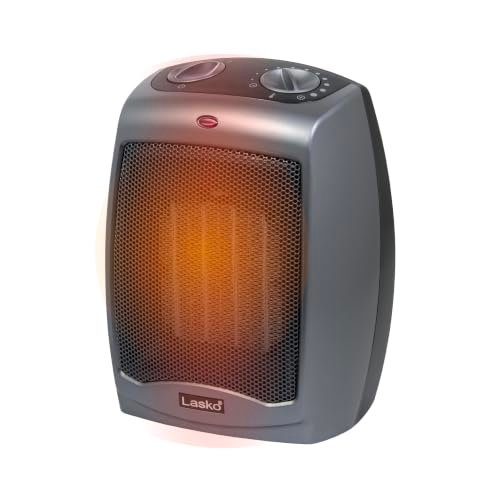
Around $30, this is the budget pick — chosen over its more famous sibling on one documented detail: the 754201 has a tip-over safety switch; the long-running 754200, per Lasko’s own Amazon comparison tables, does not. Everything else is honest budget ceramic: 1,500 W, a manual thermostat, overheat protection and a cool-touch exterior, in a 9.2-inch, 2.93 lb box with a carry handle, for a desk, a small bedroom or the one cold room in the house, at a listed ~100 sq ft class.
Honest trade-offs: no timer, no remote, no oscillation, no digital thermostat — you set a dial and learn its feel. The manual thermostat also cycles less precisely than Picks 1 and 4, which is exactly the running-cost lever from the physics section — on a budget heater, your habit (low setting, off when you leave) is the ECO mode. And 100 sq ft class means it warms a person and a small room, not a living room.
Full comparison
| Lasko CT18950 ⭐ | Vornado MVH | De’Longhi EW7707CM | Dreo DR-HSH004 | Lasko 754201 | |
|---|---|---|---|---|---|
| Price | Check product page | ~$80–100 class | ~$130 class | Check product page | ~$30 class |
| Type | Ceramic tower | Fan-forced vortex | Oil-filled radiator | PTC ceramic | Ceramic, tabletop |
| Watts | 1,500 · 3 settings | 1,500 · 3 settings | 1,500 | 1,500 | 1,500 |
| Thermostat | Digital 60–90°F | Dial, 7 settings | Dial + ComforTemp | Digital 41–95°F | Manual dial |
| Oscillation | 120° | No — vortex | No | 70° | No |
| Tip-over + overheat | Both | Both | Overheat / thermal cut-off | Both | Both |
| Noise | Fan (maker <40 dB) | Fan, quiet class | Silent | Fan, quiet class | Fan, quiet class |
| Warranty | 3 yr | 5 yr | 3 yr | 12 mo → 30 mo | 3 yr class |
Which room, which heater? (the 30-second version)
- Living room / main bedroom, one heater to start: Pick 1. Tower footprint, full safety package, remote and timer.
- “Hot spot, cold corners”: Pick 2. Circulation is the product.
- Bedroom at night, light sleeper, nursery-adjacent: Pick 3 — with the official rule kept: heaters go off when you sleep; switch it on earlier in the evening so the room is already warm at bedtime.
- Home office, fast heat at 8 a.m., precise temperature: Pick 4.
- Desk, spare room, second heater, tight budget: Pick 5 — and verify the model number ends in 1 before you pay.
When NOT to buy (yet) — the honest section
- The room is cold because of a draft, not the heating system. Seal the window/door gaps first (that job is in the Fall Checklist); a heater fighting a draft runs flat-out all day at 27¢ an hour.
- You need to heat the whole house. Space heaters are supplemental by design. If every room needs one, the furnace/heat pump needs a technician, not five heaters — and running several 12.5 A heaters at once is a circuit problem before it is a comfort solution.
- The bathroom. Only heaters specifically rated for bathroom use (with the appropriate safety plug) belong near water. None of the five picks is sold on that basis here, so none is recommended for it.
- A garage or workshop with vehicles, fuel or sawdust. That is a different heater class (and, for combustion heaters, a ventilation and CO conversation) — deliberately a separate future guide, not a paragraph here.
FAQ
Should I plug a space heater into an extension cord or power strip?
Never. Plug it directly into a wall outlet — full stop. A space heater draws about 12.5 amps continuously, and extension cords and power strips are not built for that sustained load; overheating cords are a documented fire path in NFPA and CPSC guidance. If the outlet you need is not where the heat is needed, move the heater (within the 3-foot rules) — not the electricity.
How do I choose the right size space heater for my room?
Use about 10 watts per square foot. A standard 1,500 W heater suits roughly 150 sq ft of closed, reasonably insulated room as supplemental heat. High ceilings, poor insulation and open plans all push the real need up — and since plug-in heaters cap at 1,500 W, the answer for a big open space is whole-room circulation (Pick 2) or heating in zones, not a mythical bigger model.
How much does it cost to run a 1,500 W space heater?
At full power it uses 1.5 kWh per hour — about 27¢ an hour at the 2026 US average residential rate of ~18.3¢/kWh, or roughly $66 for a month of 8-hour days. Run flat-out for a full 24 hours it would use 36 kWh (1.5 kW × 24 h) — roughly $6 a day at a national-average rate of about 17¢/kWh — which is exactly why the safety rule (off when you leave, off when you sleep) is also the money rule. Real bills are usually lower because a thermostat cycles the heater off part of the time. The formula for your own rate: watts ÷ 1,000 × hours × your price per kWh.
Is it cheaper to use a space heater or turn on the heat?
It depends on how you use it — and this is the comparison the bill actually turns on. A space heater wins when it lets you turn the whole-house thermostat down and heat only the room you’re in: warming one occupied room at ~27¢ an hour beats keeping every room in the house at comfort temperature. It loses when it runs on top of a house already heated to full comfort — then it is pure addition. The fuel matters too: against gas central heat, which usually delivers a unit of heat cheaper, the space heater’s win is narrower and mostly about zoning; against electric-resistance central heat (baseboards, an electric furnace), zoning with a space heater wins clearly; and a heat pump, above its cold-weather limit, moves heat more cheaply than any resistance heater makes it. Rule of thumb: space heater plus a lowered thermostat = savings; space heater plus an unchanged thermostat = a bigger bill.
Are space heaters safe to leave on overnight or unattended?
The official NFPA/USFA guidance is no: turn the heater off when you leave the room or go to bed, even if it has a tip-over switch, overheat protection and a timer. Those features are the backup layer. For bedrooms, pre-warm the room before bed, then off.
What is the safest space heater to use at night?
The honest answer follows from the question above: the safest night-time setup is a warm room and a heater that is off while you sleep — that is the official guidance for every type. If a room must be pre-warmed, the silent oil-filled pick (Pick 3) is the one designed for slow, steady evening warm-up: switch it on early, let it bring the room up, then off at bedtime. No model in this guide — or any guide — should be sold as “safe to run unattended all night”; the safety features are the backup, not the plan.
Ceramic, oil-filled or vortex — which type is actually best?
None is more “efficient” — all plug-in electrics turn electricity into heat at essentially 100%. They differ in delivery: ceramic fan heaters are fastest with some noise; oil-filled radiators are silent and steady but slow; vortex models even out a whole room’s temperature. Match the delivery to the room, which is how the five picks in this guide are organised.
Do space heaters use a lot of electricity?
While running at full power, yes — 1,500 W is one of the largest single loads in a home, and yes, run carelessly it will raise the electric bill a lot. The savings case for a space heater is zone heating: warming the one occupied room and turning the whole-house thermostat down. The waste case is running one flat-out, all day, in an empty or drafty room. The thermostat — and your habits — decide which case you’re in.
Can a space heater heat a whole house or a large room?
Not as designed. These are supplemental, one-closed-room heaters. A large open-plan space needs circulation help and realistic expectations, and a whole house needs its heating system serviced. Anyone whose copy promises a tiny plug-in unit heating 1,000 sq ft as primary heat is selling the claim, not the physics.
What is the safest type of space heater?
Safety lives in the model, not the type: a listed unit (UL/ETL/CSA seal) with a thermostat, overheat protection and a tip-over shut-off, used under the 3-foot and direct-to-wall rules. This guide excluded two famous models — including a best-selling tower — because their own brand’s comparison table lists them without a tip-over switch. Verify the exact model number before you buy, every time.
Why does my space heater trip the breaker?
Because 12.5 amps is most of a standard 15-amp circuit. Anything else meaningful on the same circuit — a hair dryer, a microwave, another heater — will push it over. Give the heater a circuit with headroom, never “solve” it with a bigger breaker, and if the plug or outlet runs hot, stop and have an electrician look at it.
Do space heaters dry out the air?
A heater doesn’t remove moisture from the air, but warmer air feels drier because its relative humidity drops — and fan-forced models move that air across you, which is why they get the blame. If dryness bothers you, the oil-filled pick’s gentler delivery is the usual comfort answer, alongside the room humidification you may already run in winter. No heater in this guide makes medical claims, and neither do we.
What’s the free cheat sheet?
A one-page PDF with the comparison table, the sizing table (10 W per sq ft), the running-cost table and the NFPA safety checklist. Download the Space Heater Safety & Sizing Cheat Sheet (PDF)
Read next: Fall Home Maintenance Checklist · How to Fix a Damp Basement · Essential Tools for New Homeowners