Disclosure: This post contains affiliate links. If you buy through them, Vital Dwelling may earn a commission at no extra cost to you. We only recommend products we would use in our own homes.
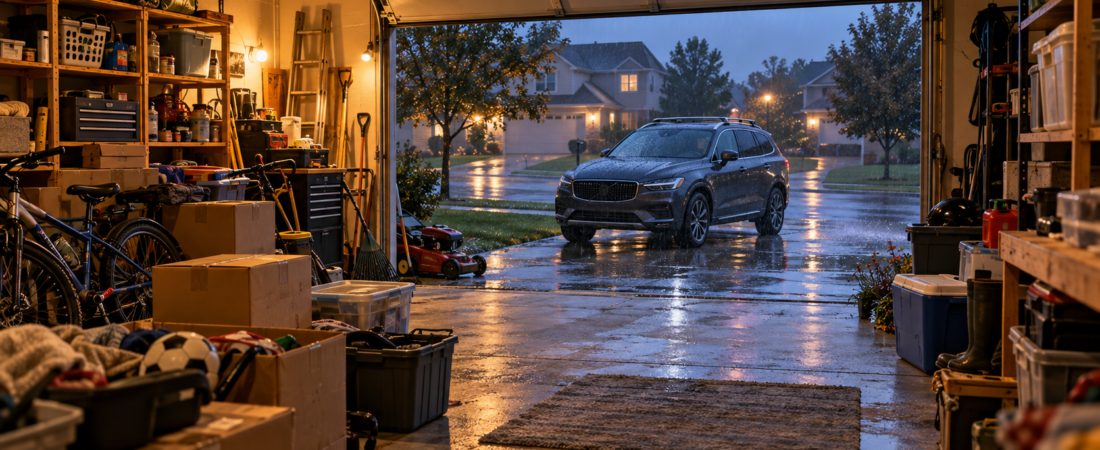
Surveys keep finding the same embarrassing number: roughly 1 in 4 homeowners can’t park a car in their own garage. The car — the second most expensive thing most families own — sits in the rain while the garage shelters boxes nobody has opened since the move. This guide fixes that in one weekend with a simple system: sort honestly, divide the garage into 4 zones, and get everything off the floor. No renovation, no custom cabinets required.
Watch the Guide
Why Garages Fill Up (It’s Not Laziness)
A garage has no system: flat floor plus no assigned places means every object lands wherever it fits, and “temporary” piles become permanent. Flat surfaces collect things — that’s physics, not character. The fix is not more willpower. It’s giving every category of stuff a zone, a container, and a home off the floor.
The System: 4 Zones
1. The Everyday Zone — by the door into the house. What you touch weekly: recycling, sports gear in rotation, the step stool, pet food. Prime space goes to prime-frequency items.
2. The Tool & Workbench Zone — one wall. The workbench, pegboard and your core tools (the set from our essential tools guide). This is the garage’s workshop, and it stays a workshop — not a dumping strip.
3. The Yard & Outdoor Zone — by the garage door. Mower, hoses, patio gear: things that live outside should live nearest the outside.
4. The Seasonal Zone — the far wall, the high shelves, the ceiling. Holiday decorations, camping gear, the off-season tires. What you touch twice a year gets the least convenient space — that’s the point.
The Weekend Plan
Saturday morning — empty and sort. Everything comes out; the driveway becomes a free sorting table. Four piles: Keep, Donate, Sell, Trash. Be ruthless with the classics: empty boxes kept “just in case,” dried-out paint, the broken chair to fix “someday.” Most garages shrink by a third in this step alone.
Saturday afternoon — clean and plan. Sweep, check for oil stains and pests, and sketch the 4 zones on the free printable Zone Plan at the end of this guide. Measure the walls while you’re at it — you’ll need the numbers when you buy storage.
Sunday — install and load. Shelving first, then wall storage, then bins. Load zone by zone, heaviest items lowest, and label as you go — not “later.” Roll the car in Sunday evening.
The Rules That Keep It Working
- The floor is for cars. Everything else goes on a shelf, a hook, or a wall. If it must touch the floor, it has wheels — or it’s the mower.
- Heavy low, light high. Paint cans and toolboxes never go overhead. Bulky-but-light (holiday decor) is ceiling-rack cargo.
- Like with like, in clear bins, labeled. If you can’t see it or read it, you will buy a second one.
- Walls before shelves, ceiling before the walls are full. Vertical space is the free square footage nobody uses.
- One in, one out. The system survives because new stuff evicts old stuff. (The seasonal swap on our fall maintenance checklist is the perfect moment for it.)
What You Need
- A heavy-duty steel shelving unit — the backbone of the system. Look for a boltless rivet design you can assemble with a mallet, and anchor it to the wall once it’s loaded.
- A wall rail-and-hook storage system — one rail turns a blank wall into parking for bikes, ladders, chairs and every long-handled tool you own, and the hooks move as your needs change.
- Clear stackable bins with lids — sized to your shelves, one category per bin, with latches that actually stay shut when you pull a bin down.
- An overhead ceiling storage rack — the Seasonal Zone’s home. Check your joist spacing and the garage door’s clearance before you order.
- Labels you can read from six feet away — they’re printed in the free Zone Plan below.
Safety Rules Nobody Mentions
Gasoline and propane never live near the water heater or any pilot light — ideally in a vented corner away from ignition sources. Paint, solvents and pesticides go on a high shelf or in a lockable cabinet, out of kids’ reach. Nothing heavy goes overhead, ever: ceiling racks are for light-and-bulky only. And keep a clear walking path plus a fire extinguisher by the house door — findable in the dark, in five seconds.
What It Costs: DIY vs. Pro
A weekend of DIY storage gear runs about $150–$450. A professional garage organizer with installed systems typically runs $1,000–$3,000+. The DIY version gets you 90% of the result — the zones and the floor rule do the heavy lifting, not the hardware.
Common Mistakes
Buying organizers before sorting. Storage for stuff you should have donated is just expensive clutter. Clearing the floor but skipping zones. Without assigned places, the piles regrow within a month. Opaque, unlabeled bins. Out of sight means bought twice. Prime space for seasonal stuff. The holiday lights do not need the wall by the door; your weekly gear does.
Frequently Asked Questions
How long does this really take? One honest weekend for a typical one- or two-car garage: a day to empty and sort, a day to install and load. A 15-minute monthly reset keeps it that way.
My garage is tiny. Does this still work? Yes — zones matter more, not less, in a small garage. Walls and ceiling carry the load; measure before you buy.
I rent. Can I do this without drilling? Mostly: freestanding shelving and bins need no holes at all. Skip the ceiling rack and wall anchors if your lease forbids them.
What do I do with old paint and chemicals? Don’t trash them — most counties run household hazardous-waste drop-off days; check your city’s website for the next one.
Where does the workbench go? On the wall with the best light and an outlet. And once it exists, guard it: a workbench that becomes a shelf stops being a workbench.
Free Printable: Garage Zone Plan
The 4-zone map to sketch your garage, the Saturday sort checklist, and the label list — on one page: Download the Garage Zone Plan (PDF). Print it before you touch a single box.
By Sunday evening the car is inside, the floor is clear, and everything in the garage has an address. And when the seasons change and it’s time to swap the gear back, the fall checklist will walk you through the house side of the same habit.