This article contains affiliate links. If you buy through them, we may earn a small commission at no extra cost to you. It helps keep Vital Dwelling guides free.
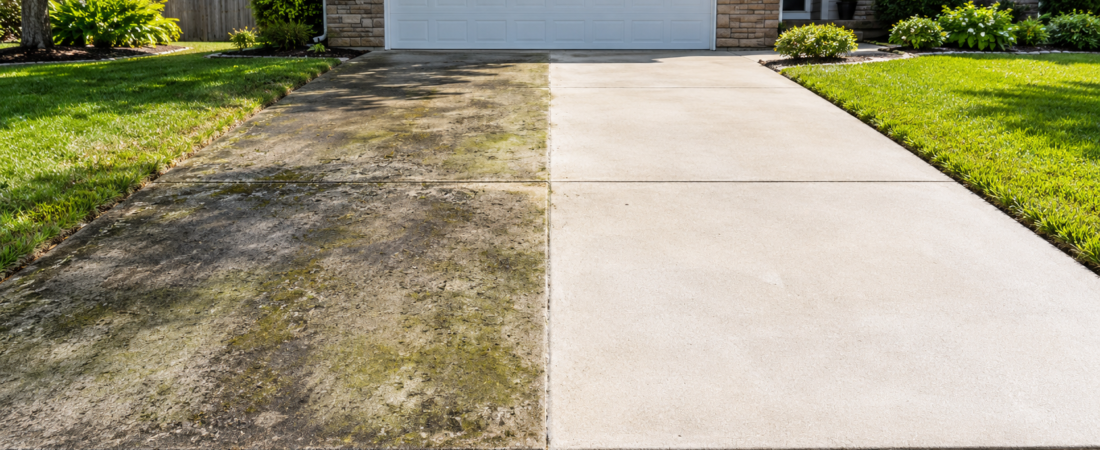
A pressure washer is the most satisfying tool a new homeowner can own. In one afternoon it can make a gray, algae-streaked driveway look freshly poured and turn a green-furred fence back to the wood color you forgot it had.
It is also the fastest way to damage your own house. Used wrong, the same machine etches concrete, shreds wood, forces water under siding, and shatters window screens. The difference between the two outcomes is not talent — it is three things: the right pressure (PSI), the right nozzle tip, and a simple technique. This guide covers all three, in plain English, before you pull the trigger for the first time.
Watch the Guide
The 60-Second Version
If you read nothing else, read this:
- For most homes, an electric pressure washer (1,800–2,300 PSI) is enough. Gas models are for big driveways, farms, and second-story work.
- The green 25° tip is your default. The white 40° tip is for delicate surfaces. The red 0° tip almost never belongs on a home.
- Distance is your pressure dial. Start 12–18 inches away and move closer only if the dirt stays.
- Detergent does the cleaning; pressure does the rinsing. Let soap dwell 5–10 minutes before you wash it off.
- Keep the wand moving. A stationary jet carves lines into wood and concrete in seconds.
Part 1: PSI and GPM, Explained Simply
Two numbers describe every pressure washer:
- PSI (pounds per square inch) — how hard the water hits. This is cutting power.
- GPM (gallons per minute) — how much water flows. This is rinsing power: how fast you clear the dirt the jet loosened.
Multiply them and you get Cleaning Units (CU = PSI × GPM), the fairest way to compare two machines. A 2,000 PSI washer at 1.8 GPM (3,600 CU) will out-clean a 2,800 PSI washer throttled to 1.1 GPM (3,080 CU) on a big flat driveway, because flow is what carries the grime away.
For a typical house, driveway, and deck, look for roughly 1,800–2,300 PSI and 1.4–2.3 GPM — the electric sweet spot.
Part 2: Electric or Gas? (And Our Pick)
Electric — right for most new homeowners. Quiet, light, no oil or winterizing, starts with a button, and strong enough for driveways, siding, decks, fences, and cars. Our pick for beginners: the Westinghouse ePX3100 (2,300 max PSI, 1.76 GPM, five quick-connect nozzles, onboard soap tank) — enough cleaning units for real work without the gas-engine headaches.
Gas — only if you need it. 2,800 PSI and up, for very large concrete areas, paint prep, or a property where an outlet is never nearby. More power also means more ways to damage things while you learn.
The rental rule still applies: if you only wash once a year and your driveway is huge, rent a gas unit for a day instead of storing one.
Part 3: Nozzle Tips — The Colors That Matter
Pressure washer tips are quick-connect and color-coded by spray angle. The narrower the angle, the harder the water hits one spot.
- 🔴 Red — 0°: a pencil-thin jet that can cut skin and groove concrete. Pros use it for a few stubborn spots, from a distance. Beginners: leave it in the tray.
- 🟡 Yellow — 15°: heavy-duty stripping on hard concrete and metal. Too aggressive for wood.
- 🟢 Green — 25°: the all-purpose workhorse — driveways, pavers, fences, siding prep. Start here.
- ⚪ White — 40°: a soft, wide fan for wood decks, cars, and rinsing. Hard to do damage with this one.
- ⚫ Black — 65° soap tip: low pressure, wide pattern. Its real job is pulling detergent from the soap tank — use it to apply soap, then switch back to green or white to rinse.
Swapping tips is your first pressure adjustment. Stepping back is your second. Use both before blaming the machine.
Part 4: Safe PSI by Surface
Save this table (it is also in the free printable at the end):
| Surface | PSI range | Tip | Notes |
|---|---|---|---|
| Concrete driveway | 2,500–3,000 | Green 25° | A surface cleaner makes this twice as fast |
| Concrete pavers | 1,500–2,000 | Green 25° | Expect to refill joints with sand after |
| Wood deck | 500–1,200 | White 40° | Keep 12″+ away; never gouge to “get it clean” |
| Vinyl siding | 1,000–1,500 | White/green | Spray downward, never up into the laps |
| Brick | 1,500–2,000 | Green 25° | Old mortar? Test gently first |
| Car / truck | 1,200–1,900 | White 40° | Stay 12″+ from paint and seals |
| Windows & screens | — | Don’t | Garden-hose pressure only |
About pavers: washing is step one of restoring them. After they dry for at least 48 hours, that is the moment to re-sand the joints and seal — we walk through the whole process in our guide on how to seal concrete pavers.
Part 5: The Technique (Step by Step)
- Prep the area. Move furniture and pots, sweep loose debris, close windows and doors, cover outlets and delicate plants. Put on safety glasses and closed shoes.
- Connect and purge. Garden hose to the washer, wand hose on, water ON first — then run the trigger for 30 seconds to push air out before starting the motor.
- Test a hidden spot. An inconspicuous corner, at your planned distance. Check for damage before doing the visible area.
- Apply detergent low-pressure. Black soap tip, bottom-up on siding (so soap doesn’t streak down dry, dirty walls). Let it dwell 5–10 minutes — do not let it dry on the surface.
- Wash in overlapping passes. Hold the wand at a 45° angle, 8–12 inches from the surface, and sweep side to side like you are painting — constant motion, overlapping each pass by a third. Rinse siding top-down so dirty water runs over already-clean wall, not clean over dirty.
- Work away from yourself. Start at the far end and wash the dirty water toward the drain or lawn — never back over your clean path.
- Shut down in order. Motor off, water off, then squeeze the trigger to release pressure before disconnecting anything.
Part 6: Two Upgrades That Change Everything
- A 15-inch surface cleaner (our pick: the Kärcher 15″ Surface Cleaner — a dual-nozzle rotary model that fits most electric and gas washers) — it hovers over concrete on two spinning jets, cleaning a wide path evenly with no zebra stripes. On a driveway it is easily a 2–3× speed-up and the single best accessory you can buy.
- The right detergent — concrete: a driveway & concrete concentrate (our pick: Simple Green Oxy Solve Concrete and Driveway Cleaner); siding: a house-wash formula. Skip bleach mixes while you are learning — the dedicated products are safer for plants, pets, and the machine’s seals.
- Bonus for cars and siding: a foam cannon (our pick: the Tool Daily Foam Cannon) lays down thick soap that dwells longer and lifts dirt before you rinse.
Part 7: 6 Mistakes That Damage Your Home
- Reaching for the red tip. It solves “stubborn” by removing surface along with the stain.
- Holding the jet too close. Closer is not cleaner — it is deeper etching. If it is not cleaning at 8 inches, you need detergent and dwell time, not 2 inches.
- Washing a wood deck like concrete. High pressure furs and splinters wood grain permanently. Low PSI, wide tip, keep moving.
- Spraying up into siding laps. Water driven upward gets behind the siding and into the wall — exactly where you never want it.
- Using a ladder with a pressure washer. The trigger kick pushes you backward. Wash second stories from the ground with an extension wand, or hire it out.
- Pointing the wand at people, pets, or your own feet. A pressure jet can inject water through skin — a genuine emergency-room injury. Treat it like a power tool, because it is one.
After Washing: The Smart Next Steps
- Let hard surfaces dry fully before judging the result — concrete lightens a lot as it dries.
- Pavers: sweep in fresh joint sand once dry, then consider sealing (see the paver guide linked above).
- Wood: wait 48 hours before staining or sealing a washed deck.
- Store the washer drained; if it lives in a freezing garage, run pump-saver through it first.
FAQ
Can I pressure wash my roof? No — standard asphalt shingles lose their protective granules under pressure. Roofs need a soft-wash treatment by a pro.
How often should I wash my driveway and siding? Most homes: siding every 1–2 years, driveway and walkways once a year. Humid climates grow algae faster.
Will pressure washing remove oil stains from concrete? It lightens them. For real removal, pre-treat with a degreaser and hot water (a pro service) — pressure alone rarely erases oil.
Do I need a gas washer for a two-story house? Not for the walls — detergent, dwell time, and a second-story nozzle kit from the ground handle most siding. Distance, not raw PSI, is the limit.
The Bottom Line
Pressure washing rewards patience, not power. Pick the electric machine that fits a normal home, live on the green and white tips, let detergent do the hard work, and keep the wand moving. Do that, and the “after” photos take care of themselves.
Want the printable version? The one-page PSI-by-surface chart from this guide is free to download — tape it inside the garage cabinet and you will never guess at a setting again.